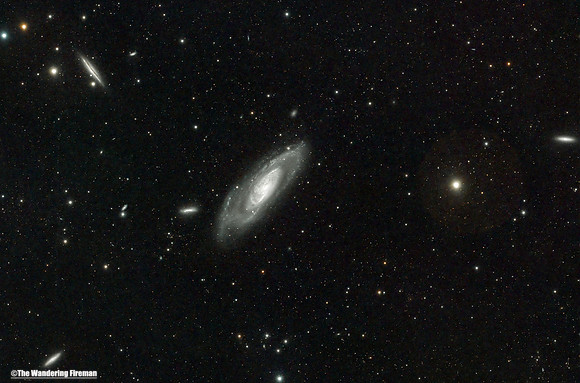
Messier 106
Messier 106 (also known as NGC 4258) is an intermediate spiral galaxy in the constellation Canes Venatici. It was discovered by Pierre Mehain in 1781. M106 is at a distance of about 22 to 25 million light years away from Earth. M106 contains an active nucleus classified as a type 2 seyfert, and the presence of a central super massive black hole has been demonstrated from radio wavelength observations of the rotation of a disk of molecular gas orbiting within the inner light year around the black hole. NGC 4217 is a possible companion galaxy of Messier 106. Besides the two visible arms, it has two "anomalous arms" detectable using an X-ray telescope.